


THANK YOU ALL FOR COMING to The National Neurodiversity Show in Wales!
TICKETS ARE NOW AVAILABLE TO THE NATIONAL NEURODIVERSITY SHOW WALES 2027!

Special thanks to our amazing exhibitors, speakers, staff team, sponsors @remtekworkplace and @themwordcic, media partners @thesendcast and @autismeyemagazine, plus @innovationphotography and @f9films for capturing the day so brilliantly.
View the full official gallery here:
https://nationalneurodiversityshows.com/national-neurodiversity-show-wales-cardiff-city-stadium-30th-april-2026-gallery/
View our highlights video from Wales on Facebook here; https://fb.watch/Hc4tZXpKJI/
View our highlights video from Wales on Youtube here; https://youtu.be/UcL8RSzlt7Q?si=qxq2CnEc1ugXRXFJ
 Date: 20th May 2027
 Show Hours: 10:00 AM – 4:00 PM
Parking is FREE and on site
Feel free to arrive at any time during the day — there’s no need to be there right at the start.
The 2027 show will feature an exhibition floor full of organisations offering advice, support, products, and services tailored to the neurodivergent community. Plus, enjoy a full schedule of insightful seminars running throughout the day across three dedicated seminar rooms. Scroll down to see our LIVE seminar schedule and Exhibitor List.
Features; Quiet Room, Exhibition Café, Breakout Areas, Unlimited Seminars, Device Charging
Dedicated BSL meeting point in reception. BSL supported Exhibition Tours are at; 10:15am, 12:15pm & 2:15pm.
We can’t wait to welcome you back!

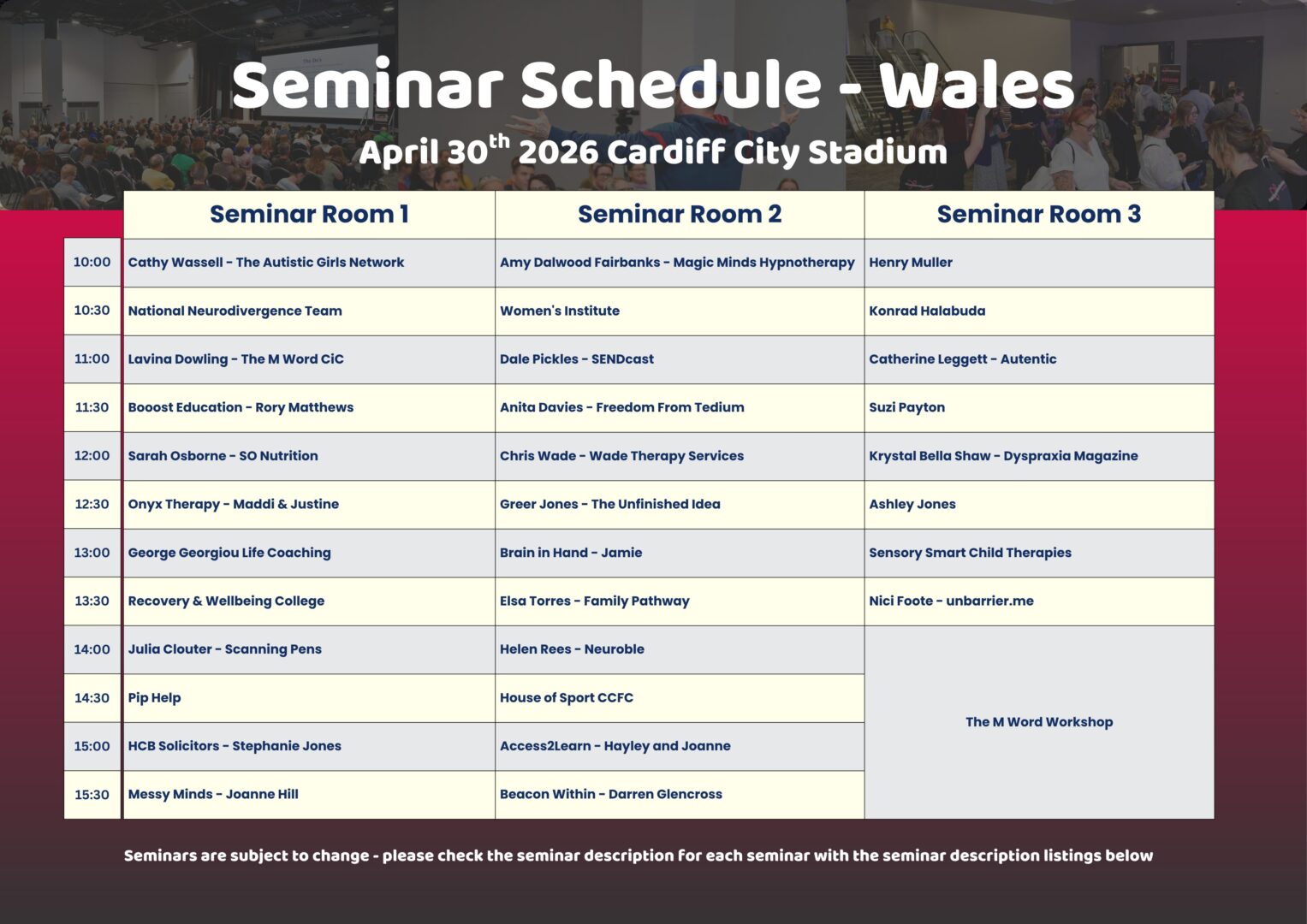

10:00am
Cathy Wassell;
The Haven by Autistic Girls Network;
Inclusive Education and Support for Neurodivergent Learners
This presentation provides an overview of creating truly inclusive educational environments where neurodivergent learners can flourish. We'll explore key principles of neurodiversity-affirming practice, moving beyond awareness to action.
The session will emphasise the importance of understanding individual strengths, fostering positive learning identities, and building collaborative partnerships between educators, families, and support professionals.
We will also give practical examples of how these principles are applied within The Haven, an online school designed specifically for neurodivergent learners.

10:30am
Neurodivergence Wales;
Who are the National Neurodivergence Team and What do they do?
The National Neurodivergence Team is funded by
Welsh Government to help improve the lives of neurodivergent people and their
families across Wales. They do this in a number of ways – through co-produced
training and resources, practice sharing and promoting the needs of neurodivergent
people.
This short presentation will outline the work of the Team and some of the
bilingual, free-to-access resources that are available on their website
(www.NeurodivergenceWales.org)

*KEYNOTE SPEAKER*
SEMINAR SPONSOR
11:00am
Lavinia Dowling;
The M Word CiC; Might you be neurodivergent? Let’s explore together and consider some clues to look for
Whilst Autism and ADHD are hot topics of the day and lots of ‘wannabe’ coaches are materialising everywhere, you need to ask yourself the purpose of why it is helpful to consider neurodiversity. Let me help you as a Mental Health and Autism nurse specialist guide you to not only considering whether you are neurodivergent but also consider anxiety and low mood into the mix that make your profile more unique. By exploring together, we will uncover the clues that guide you further to understanding yourself more so but also identifying traits of Autism and ADHD.

11:30am
Rory Matthews;
Booost Education;
No Budget? No Problem! Everyday Tech Tips for Neurodivergent Learners
Who says you need fancy software to study smarter?
From YouTube to ChatGPT, this session explores how everyday (and free!) tech can support focus, memory, and motivation — especially for neurodivergent minds.
Don't miss this informative session from Booost Education on technology for neurodivergent minds.

12:00pm
Sarah Osborne, BA(Hons) mBANT rCNHC;
SO Nutrition;
Building Resilience with Diet and Nutrition for Neurodivergence
This empowering seminar offers valuable insights, tools, and actionable strategies to enhance resilience through balanced eating while respecting your unique needs. Led by a nutritionist and emotional eating practitioner who runs a neurodivergent nutrition clinic, this seminar will present the latest evidence-based approaches for fostering a healthier, more resilient relationship with food.

12:30pm
Maddi and Justine;
Onyx Therapy; Thinking About Thinking: Using Metacognition to Support Regulation and Self-Advocacy
This seminar explores metacognition — the ability to notice, understand, and reflect on our own thinking, emotions, and bodily states — and why it is a foundational skill for emotional regulation, executive functioning, and self-advocacy.Led by clinicians from Onyx Therapy, this session will break down what metacognition really is (beyond buzzwords), why it matters, and how it can be taught explicitly and safely. We will explore how developing metacognitive awareness helps people recognise early signs of dysregulation, understand what supports they need, and communicate these needs with confidence — rather than relying on crisis-based responses.The seminar will include practical, neuroaffirming strategies that can be used in classrooms, homes, ARPs, and EOTAS contexts. Attendees will also be introduced to Onyx Therapy’s metacognition-focused resources, designed to support reflection, regulation, and self-advocacy in ways that are accessible, strengths-based, and respectful of neurodivergent experiences.

1:00pm
George Georgiou; Mind Your ADHD
Stop Suffering With ADHD. Start Mastering It
This talk is for the professional, business owner, engineer, or high-achiever who looks successful on the outside but feels exhausted, inconsistent, or at war with their own mind.
For the first time, George, the founder of the worldwide recognised and accredited Mind Your ADHD Academy shares how ADHD nearly cost him everything, including his health, future family, and sense of self worth and how rewiring subconscious patterns changed it all.
Attendees leave with a clear three-step framework to eliminate daily ADHD struggles, regain emotional control and focus, and finally turn ADHD into an effortless advantage in life, career, and business.

1:30pm
Recovery and Wellbeing College - NHS Cardiff and Vale;
Does an ND aware approach make a difference in a Recovery & Wellbeing College?
Recovery colleges offer free psychoeducational courses for everyone. But are they neurodivergent friendly? Do they make any provision for individuals who are neurodivergent? Do they need to? Join Georgia Howard, who is both neurodivergent and works for Cardiff and Vale Recovery & Wellbeing College, as she delves into this question and looks at the practical steps that can be taken to make a positive difference in a neurodivergent person’s experience of attending Recovery College courses. Georgia will also give a breakdown of some of the neurodivergent focussed courses the college offers.

2:00pm
Julia Clouter:
Scanning Pens;
Reading at the Point of Need: Simple Tools that Change Lives
In this session, Julia Clouter explains how simple tools can build reading confidence for neurodiverse people at work, in education, and at home. She will share real case studies from frontline services, families, and universities. Julia will show practical ways to give support at the exact point a person needs to support. Delegates will learn how a range of technology increases independence and remove common barriers. The session will also signpost REMTEK, who provide assistive technology services that help people get the support they need. Through videos and lived experiences, the seminar shows how small changes can make an immediate difference.

2:30pm
Pip Help CiC;
Important Information Concerning PiP Applications
Seminar Information Coming Soon

3:00pm
Stephanie Jones;
Solicitor from HCB Solicitors;
How to secure an IDP;
How To Secure Funding For Your Child With SENs
Join one of the leading legal firms in the UK to hear how to secure funding for your child with special educational needs. Specialists from HCB Solicitors will explain how Educational Health and Care Plans and IDPs work and how this skilled and well practised firm will support your family to obtain the support you need.
This is a practical guide for parents and carers on securing a robust IDP, with step‑by‑step advice, FAQs, and a live Q&A.

3:30pm
Joanne Hill; Messy Minds;
The Mask
Using The Mask as a powerful metaphor, this session explores masking, the way many neurodivergent people suppress or edit themselves to fit in and the impact this has over time.
Through lived experience and reflection, Joanne unpacks the difference between hiding, unleashing, and understanding your strengths, and why real progress comes from control rather than suppression.
A thoughtful, human session about ADHD, identity, and what changes when you stop pretending and start working with your brain, not against it

10:00am
Amy Dalwood-Fairbanks;
Magic Minds Hypnotherapy;
After School Meltdowns to Moments of Connection
In this seminar, Amy from Magic Minds Family Hypnotherapy explores the common experience of after-school meltdowns in neurodivergent children and how to respond with calm and compassion. She explains the underlying causes of these emotional explosions, and highlights the vital role of co-regulation to help the child regain control. Amy introduces the After-School Meltdown Toolkit, a set of simple, soothing tools designed for both parents and children to use in these challenging moments. With a focus on hypnotherapy, she demonstrates how brief, calming techniques can support both emotional regulation and meaningful connection. Parents will leave with practical strategies and a hopeful message: by being present and regulated themselves, they can transform meltdowns into moments of connection.

10:30am
The WI Thinking Differently Campaign: Community Action, Neurodiversity, and Advocacy in Practices
This seminar explores how the WI has drawn national attention to the experiences of autistic women and girls, and women and girls with ADHD.Discover how WI members have transformed lived experiences into action- from awareness-raising and surveys to craftivism, awareness days, and a parliamentary event amplifying community voices. We’ll share key findings, lessons learned, and the power of collective storytelling in influencing policy and public understanding. Whether you’re interested in advocacy, health equity, or community-led change, this session offers practical insights and inspiring examples of how local action can drive meaningful national conversations. You will also have the chance to hear about how the WI has explored the intersection of neurodiversity, dental health, and violence against women through creative grassroots campaigning.

*MEDIA PARTNER*
11:00am
SENDcast Podcast
2026 Seminar Description Coming Soon

11:30am
Anita Davies; Harnessing Your ADHD Brain
Join us for a seminar designed to show you that an ADHD brain is far from broken. We'll discuss how neurotypical thinking often doesn't suit our minds and explore how it feels to experience controlled ADHD. We'll discuss strategies to leverage the unique strengths of ADHD, minimising overwhelm and frustrations. This session offers valuable insights for embracing and optimising your ADHD brain.

12:00pm
Chris Wade; Wade Therapy Services
Seminar information coming soon

12:30pm
Greer Jones;
The Unfinished Idea; 3 Step Rest
When dysregulation hits, a child melts down, your brain blanks, or your body goes into fight, flight, or freeze. This seminar is not about fixing everything. It is about finding your footing. Greer Jones shares a simple 3-step reset you can use in real time to move from overwhelmed to steadier. You will learn how to spot early signs, downshift your nervous system, and choose a next step that protects connection, safety, and dignity. No perfect calm required, just a pathway back. Designed for parents raising neurodivergent children. You will leave with simple phrases to use and a take-home reset prompt you can screenshot.

1:00pm
Jamie from Brain in Hand;
Supporting Neurodiversity in Education and the Workplace
In this seminar, we will explore who Brain in Hand is for and why it is a powerful support tool for neurodiverse individuals and those with anxiety-related challenges. We will cover how Brain in Hand helps individuals to reduce anxiety, manage overwhelm, and thrive in education, the workplace, and daily life. Brain in Hand supports with organisation, problem solving, and task initiation, enabling individuals to establish routines, manage stress, and respond confidently when plans change or unexpected situations arise. Attendees will learn about the key features, practical applications, and the positive impact it can have on building independence, improving productivity, and supporting with wellbeing.

1:30pm
Elsa Torres; Family Pathway;
Behaviour, Belonging and the Pipeline We Don’t Talk About
Why are some children repeatedly labelled as “challenging” or “disruptive” in school — and why are boys, neurodivergent learners, and those facing disadvantage overrepresented in behaviour systems?This session explores how behaviour has traditionally been understood in education, questioning whether current approaches still prioritise control over understanding. Drawing on neuroscience and psychosocial models, it looks at how shame, identity, and social expectations shape behaviour — often misunderstood, particularly in neurodivergent children.In today’s complex world, young people are navigating identity, gender, and belonging. For some, distress shows as anger or disruption; for others, it’s internalised through anxiety, masking, or perfectionism.This session encourages educators, families, and professionals to rethink behaviour through the lens of regulation, neurodiversity, and belonging — and how we can better support children as whole individuals.

2:00pm
Helen Rees; Neuroble; Supporting Neurodivergent Individuals at Work and in Life: Executive Functions in Action
Executive Function (EF) challenges are a key, but often invisible barrier faced by many neurodivergent adults, impacting wellbeing, productivity, and inclusion in workplaces, businesses, and daily life. In this session, Helen Rees, founder of Neuroble, explores how strengths-based support can empower neurodivergent individuals to thrive.
Drawing on both lived experience and professional coaching expertise, Helen will share practical, brain-friendly strategies that individuals, professionals, and organisations can use to better support EF needs - helping to create environments where neurodivergent people can truly flourish.

2:30pm
Jo Bendon; Cardiff City Community Foundation - House of Sport; From Access to Impact: Supporting Neurodiverse Individuals Through Sport
Seminar explores the work of the Cardiff City FC Community Foundation in supporting neurodiverse individuals through inclusive, sport-based programmes. It highlights the importance of adapted provision in reducing barriers to participation and improving wellbeing. Key initiatives such as Inclusive Kicks are examined alongside measurable outcomes, including improvements in wellbeing, motivation, belonging, and social interaction. The presentation demonstrates how inclusive sport can promote engagement, confidence, and community integration for neurodiverse populations.

3:00pm
Matt Taylor; Access 2 Learn; Experiencing a Neurodiverse Diagnosis as an Adult
What happens when someone discovers they’re neurodivergent later in life? This talk explores the reality of adult diagnosis, which can bring feelings of relief, grief, clarity, uncertainty and affirmation - usually all at the same time!Drawing on testimony from a ranged of lived experiences, this session explores what can lead adults to pursue diagnosis of a neurodiversity, what the diagnostic process may involve, the challenges and opportunities that come with late diagnosis, and what meaningful support can look like post‑diagnosisThis session is centred on neurodivergent voices and is aimed at anyone curious about the realities of adult diagnosis- from those who may be considering investigating a diagnosis themselves, to clinicians, educators, and professionals supporting neurodivergent adults.

3:30pm
Darren Glencross;
Beacon Within;
Finding Your Orbit: Understanding Yourself Through a Lived Neurodivergent Lens
Many neurodivergent people grow up feeling different without fully understanding why. In this honest and reflective talk, Darren Glencross shares his late diagnosis journey and introduces Inner Orbit, a lived-experience framework designed to help people better understand themselves. Rather than focusing on deficits, this session explores identity, emotional intensity, burnout and self-acceptance through a practical and human lens. Darren offers a grounded perspective for neurodivergent individuals, families and professionals who want clearer language, deeper self-understanding and a more compassionate way of navigating life.

10:00am
Henry Muller;
The Internal ADHD Experience - What does it feel like to have ADHD in your school years and what helped me
Henry Muller – featured in the BBC documentary Inside Our ADHD Minds, will speak about what ADHD really feels like from the inside and how small changes in adult responses can make a meaningful difference.He explores the disconnect between what people see on the outside of an ADHD child vs what that young person is experiencing on the inside.
Through vivid explanation and lived experience, he helps audiences understand how that misunderstanding can lead to shame, isolation and underperformance and how we can bridge that gap with new mindsets and strategies.

10:30am
Konrad Halabuda; Life at Home and Work
When Konrad found out his son, Hunter had autism, his life shifted. However with
love, understanding and the support of people around him the family have used their
experiences to shine a light on how positivity and empathy can lead to incredible outcomes.

11:00am
Catherine Leggett;
Autentic;
Can We 'Universally Design' and Still Be Neuro-Affirming?
This seminar will be interesting, and useful, for service providers, employers, HR professionals and careers professionals and is packed with practical resources, tools and tips. Catherine is an autistic/dyslexic/dyscalculaic/dysgraphic time served professional and practitioner, having supported a diverse community of autistic individuals in their career, working with the two top autism charities in the UK. You will learn how competing neurodivergent needs can be managed, to better achieve neurodivergent affirming services, organisations and workplaces through robust, and best practice universal design

11:30am
Suzi Payton;
From Discovery to Acceptance, My Autism and ADHD Journey
Join Suzi, and AuDHD speaker and comedian, for an enlightening and entertaining journey as she shares her lived experiences of being identified with autism and ADHD as an adult.Through the highs and lows, she will take the audience on a rollercoaster ride filled with heartfelt moments and comedic storytelling.
Meet Polly Parton, a delightful character who will serenade the audience with a special song, adding a unique twist to the narrative.
This talk promises to be an inspiring blend of humour, music, and personal insights that will leave everyone with a deeper understanding of neurodivergence.

12:00pm
Krystal-Bella Shaw;
Understanding Dyspraxia: A Practical Guide for Educators, Employers, and Parents
This talk provides a comprehensive guide to understanding and supporting dyspraxic individuals, designed for educators, employers, parents, and caregivers. Learn practical strategies to foster inclusivity at school, work, and home, alongside insights into the lived experiences of dyspraxic individuals. Explore how accurate representation and advocacy can make a meaningful difference.

12:30pm
Ashley Jones;
Built Different For Business; My Story
Living with ADHD and been diagnosed at the age of 6, has always meant thinking differently, which, for a long time, felt like a hurdle. School was a whirlwind of distractions, and life was a constant struggle. Bad decisions and trying to fit in, However, when I decided to start my own business 4 years ago , I realised my unique perspective was actually an asset. My creativity and energy helped me problem-solve and innovate in ways others didn’t. While organisation and life with ADHD can still be challenging, I’ve learnt to embrace routines and tools that keep me on track. Building a business as someone with ADHD isn’t easy, but it’s taught me resilience and the value of owning my differences.

1:00pm
Karen Garner and Emma Holloway; Sensory Smart Child Therapies;
Becoming Sensory Smart
Karen Garner and Emma Holloway are Specialist Occupational Therapists working across the UK, supporting children and young people with sensory processing differences. In this session, they will explore how the nervous system shapes the way we process, respond to and experience the sensory world around us. Encouraging everyone to become ‘sensory smart’, they will show how viewing behaviour through a sensory lens can lead to deeper understanding, greater compassion and more effective and confident support for nervous system regulation. Attendees will leave with a clearer, more positive understanding of sensory and emotional regulation, and why this is key to helping children engage, learn and thrive.

1:30pm
Nici Foote;
Unbarrier.Me;
Belonging: Why Systems Fail When People Aren't at the Centre
We invest heavily in systems, tools, and frameworks. Yet engagement falls, confidence disappears, and behaviour shifts. Why? Because when belonging is missing—when people don't feel psychologically safe, trusted, or seen—nothing else sticks. In this 10-minute seminar, Nici Foote shares why belonging isn't a "nice to have" but the biological condition that makes any system work. Through real examples from schools, she'll show how to spot when it's missing and what shifts—in design, relationships, and daily practice—actually create the conditions where learning becomes possible. For educators, leaders, and anyone designing for inclusion.

2:00pm
*WORKSHOP*
Lavinia Dowling; The M Word CiC; Emotional Problem Solving;
Journalling Your Way To Better Mental Health
Journaling can take many forms — writing, postcards, photos, poetry, or songs. Sarah Wilson explored her mental health and anxiety through journaling in her book First, We Make the Beast Beautiful, later earning an honorary Doctorate and continuing to explore her neurodivergence.Lavinia has been journaling for over 40 years, using it to better understand her mental health and neurodivergent profile, boosting her confidence and self-awareness. As a qualified Mental Health Nurse, she has also supported others to do the same and used journaling in her doctoral research to uncover patterns, moods, and insights.If you’re looking to explore your mental health and neurodivergence in a relaxed and engaging way, this workshop may be for you.


